
Every website you’ve ever visited is stored on a server somewhere in the world. That server is what we call web hosting it’s the engine behind your website, keeping it online and delivering it to visitors around the clock. But when you go looking for a hosting plan, you’ll quickly run into a wall of options, pricing tiers, and technical terms that can make the whole thing feel overwhelming.
The good news is that most websites only need one of six hosting types. This guide breaks them all down in plain language — including one important distinction that most guides gloss over: the difference between managed and unmanaged VPS hosting. By the end, you’ll know exactly which type fits your situation.
1. Shared hosting
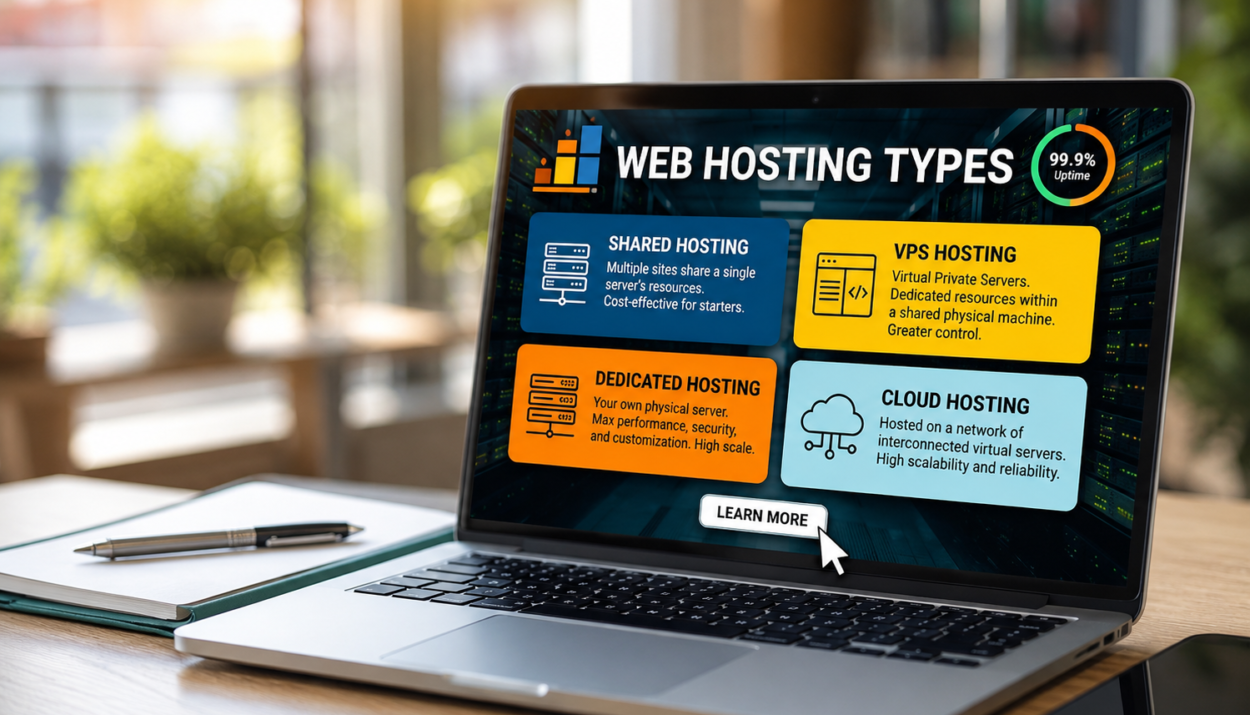
Shared hosting is where most websites start, and for good reason. Your website shares a server with hundreds of other websites, which means everyone splits the cost. That makes it by far the cheapest option available — you can often get started for just a few dollars a month.
The provider handles all the technical side: server maintenance, security patches, updates. You just log in, build your site, and publish. Most shared hosting plans come with a beginner-friendly control panel that puts everything you need in one place.
The trade-off is performance. Because you’re sharing resources, a spike in traffic on another site can slow yours down. You also have very limited ability to customise your server environment. And while security breaches are rare, a vulnerability in one site on the server can potentially affect others.
For small businesses, personal blogs, portfolios, and anyone just getting started online, shared hosting is a smart, practical choice. You can always upgrade later when your needs outgrow it.
Best for: beginners, personal blogs, small business websites, low-traffic sites.
2. Managed VPS hosting
A Virtual Private Server (VPS) gives you your own partitioned section of a physical server — your own dedicated RAM, CPU, and storage that no one else can touch. It’s a significant step up from shared hosting in terms of performance, stability, and control.
With managed VPS hosting, the hosting provider takes care of all the technical heavy lifting for you. That includes server setup and configuration, operating system updates, security patches, performance monitoring, and backups. You get the power of a private server without needing to know how to run one.
This is what makes managed VPS such a popular choice for growing businesses. You get noticeably better speed and reliability than shared hosting, you’re protected from the “bad neighbour” effect of sharing resources, and you don’t need a systems administrator on your team to keep things running smoothly.
The cost is higher than shared hosting, but for a business whose website is genuinely important to its operations, that extra investment pays for itself quickly in reliability and peace of mind.
Best for: growing businesses, ecommerce stores, WordPress sites with decent traffic, anyone who wants VPS performance without the technical management.
3. Unmanaged VPS hosting
Unmanaged VPS hosting gives you the same private server environment — your own dedicated resources, full isolation from other users, and strong performance. The key difference is that the hosting provider only supplies the server itself. Everything else is your responsibility.
That means you configure the operating system, install your own software stack, handle all security updates, set up your own backups, and troubleshoot anything that goes wrong. If the server goes down at 2am, it’s on you to fix it.
For experienced developers and system administrators, this is actually the preferred option. You get total control over the server environment — you can install exactly what you need, configure it precisely to your requirements, and often pay less than you would for a managed plan.
For anyone without that technical background, unmanaged VPS can become a nightmare quickly. A misconfigured server is a security risk, and without proper maintenance it can become unstable over time.
The bottom line: unmanaged VPS is powerful and cost-effective in the right hands. If you have the skills or a developer on your team, it’s an excellent option. If you don’t, stick with managed.
Best for: developers, system administrators, tech-savvy teams who want full server control at lower cost.
4. Dedicated server hosting
With a dedicated server, you’re not sharing anything. An entire physical machine is yours — all the RAM, all the CPU, all the storage. No neighbours, no resource competition, no shared risk.
This gives you the maximum possible performance and security. You can configure the hardware and software exactly as you need it, and the server can handle enormous volumes of traffic without any degradation in speed or reliability.
The downside is that all of this comes at a significant cost. Dedicated servers are the most expensive standard hosting option, and they require serious technical expertise to manage — unless you opt for a managed dedicated server, where the provider handles maintenance for an additional fee.
For most websites, dedicated hosting is overkill. But for large enterprises, high-traffic platforms, businesses with strict data security requirements, or organisations that need to comply with specific regulations, a dedicated server is often the only option that truly fits.
Best for: large enterprises, high-traffic websites, businesses with strict security or compliance needs.
5. Cloud hosting
Cloud hosting takes a fundamentally different approach. Instead of hosting your site on a single physical server, it distributes your site across a network of virtual servers. If one server in the network has a problem, another one picks up the load instantly — which is why cloud hosting typically offers exceptional uptime and reliability.
The other major advantage is scalability. During a traffic spike — say, you get featured in a major publication or run a flash sale — cloud hosting automatically allocates more resources to handle the load. When things quiet down, it scales back. Most providers charge a pay-as-you-go rate, so you only pay for what you actually use.
This flexibility makes cloud hosting particularly well-suited to ecommerce businesses, media sites, and any website that experiences unpredictable or seasonal traffic. It can also work well for startups that expect rapid growth but aren’t sure exactly how much resource they’ll need.
The main risk is cost unpredictability. If you have an unexpected traffic surge or don’t monitor your usage carefully, bills can be higher than expected. It also requires an internet connection to manage, and some providers can feel complex to set up compared to traditional hosting.
Best for: ecommerce sites, businesses with fluctuating traffic, startups expecting growth, medium to large-scale web applications.
6. Managed WordPress hosting
Managed WordPress hosting is built from the ground up for one specific platform: WordPress. The server environment is optimised specifically for how WordPress works — caching, database queries, PHP configuration — which typically results in faster load times than running WordPress on a generic hosting plan.
More importantly, the hosting provider manages everything on your behalf. WordPress core updates, plugin and theme updates, daily backups, security scanning, malware removal, performance optimisation — all of it is handled for you. Most managed WordPress hosts also provide a staging environment, which lets you test changes privately before pushing them live, and expert support from staff who know WordPress inside out.
The trade-off is that you’re locked into WordPress. If you ever want to switch to a different platform, you’ll need a different hosting solution. Some managed WordPress hosts also restrict which plugins you can install, particularly ones that conflict with their own caching or security systems.
For anyone using a serious WordPress site — whether that’s a blog, a business website, or a WooCommerce store — managed WordPress hosting is one of the best investments you can make. The performance improvement and reduction in maintenance headaches alone are worth it for most users.
Best for: bloggers, business websites on WordPress, WooCommerce store owners, anyone who wants a fast and secure WordPress site without the technical management.
Which one is right for you?
Here’s a simple way to think about it:
- New to websites, limited budget → Shared hosting
- WordPress site, want it fast and hassle-free → Managed WordPress hosting
- Growing site, want performance without managing servers → Managed VPS hosting
- Developer or tech team, want full control → Unmanaged VPS hosting
- High-traffic enterprise site, maximum control chose → Dedicated server hosting
- Unpredictable or seasonal traffic, need flexibility → Cloud hosting
One Final tip: whatever type you choose, always check the provider’s uptime guarantee (aim for 99.9% or above), read real customer reviews about their support quality, and make sure upgrading your plan later is straightforward. The hosting company matters almost as much as the hosting type.